Best Tripod Gimbal Heads for Telephoto Lenses

Affiliate disclosure: Some links on this page are affiliate links. If you buy through them we earn a small commission at no extra cost to you. Recommendations are research-driven; we don't claim personal use of every product reviewed. Product prices and availability are accurate as of the date published and are subject to change. Always check Amazon for current pricing before purchasing. Learn more.
Quick Picks
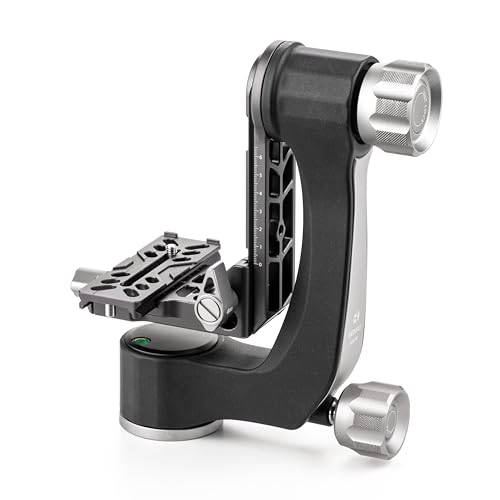
Benro Aluminum Gimbal Head (GH2N)
Carbon fiber construction keeps weight low while the manufacturer specifies a 55 lb load capacity — room enough for any super-telephoto rig
Buy on Amazon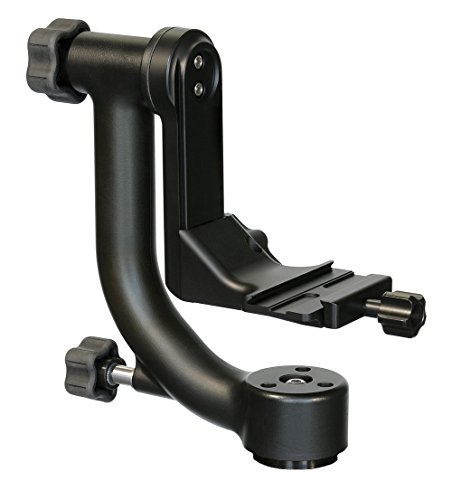
Wimberley WH-200 Wimberley Gimbal Head II - Made in USA
Assembled in Charlottesville, Virginia from 6061 aluminum and stainless steel fasteners — build quality is a stated design priority
Buy on Amazon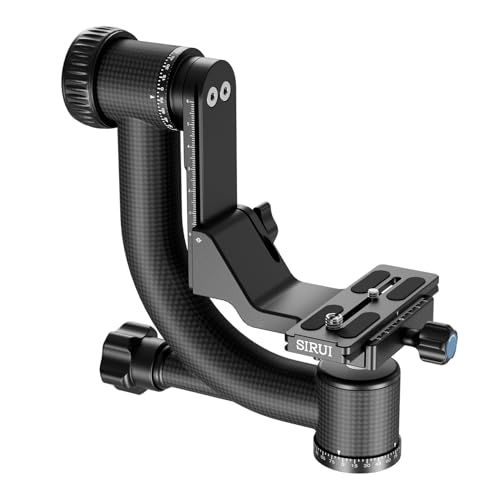
SIRUI PH-20 Gimbal Head, 360° Panoramic Tripod Head for DSLR Telephoto Lens
Eight-layer carbon fiber arm and forged aircraft aluminum platform deliver a 20 kg load rating at just 1.1 kg of head weight, per the listing
Buy on Amazon| Product | Price Range | Top Strength | Key Weakness | Buy |
|---|---|---|---|---|
| Benro Aluminum Gimbal Head (GH2N) best overall | $$ | Carbon fiber construction keeps weight low while the manufacturer specifies a 55 lb load capacity — room enough for any super-telephoto rig | Listed as aluminum in the name despite carbon fiber construction — buyers should confirm the specific model variant before ordering | Buy on Amazon |
| Wimberley WH-200 Wimberley Gimbal Head II - Made in USA best premium | $$$ | Assembled in Charlottesville, Virginia from 6061 aluminum and stainless steel fasteners — build quality is a stated design priority | Heavier and larger than carbon-fiber alternatives at the same load rating — a real consideration for travel or hiking setups | Buy on Amazon |
| SIRUI PH-20 Gimbal Head, 360° Panoramic Tripod Head for DSLR Telephoto Lens best value | $$ | Eight-layer carbon fiber arm and forged aircraft aluminum platform deliver a 20 kg load rating at just 1.1 kg of head weight, per the listing | 20 kg load ceiling rules it out for the heaviest 600–800 mm super-telephoto combinations | Buy on Amazon |
| SIRUI PH-10 Gimbal Head, 360° Panoramic Tripod Head, 15kg, 600mm Telephoto also consider | $$ | Ten-layer carbon fiber body brings the head down to 0.98 kg — the lightest full gimbal in this group according to the manufacturer | 15 kg load limit is the lowest in this group — not suitable for 500 mm f/4 or larger lenses on a full-frame body | Buy on Amazon |
| Leofoto PG-1 Gimbal Head for Telephoto Lenses, 55 lb Load, Arca-Swiss Clamp also consider | $$ | Manufacturer specifies 55 lb capacity in a head weighing just 2.2 lb — one of the strongest load-to-weight ratios listed here | A newer listing with less of a track record than the Wimberley or Benro options | Buy on Amazon |
| Leofoto Gimbal Head, Compact Outdoor Shooting Gimbal Head with 360° Pan Rotation also consider | $$ | Spirit level built into the panning base adds a precision reference point not found on every head in this group | 100 mm height adjustment range is narrower than the longer sliding platforms on the Benro GH2N and Leofoto PG-1 | Buy on Amazon |
Mounting a 500 mm lens on a standard ball head is an exercise in frustration. The moment you release the tension, the lens tips forward and the whole rig goes nose-down. A gimbal head solves this by pivoting the system around the lens’s center of gravity, so a balanced telephoto floats at whatever angle you leave it. That floating quality is what makes gimbal heads essential for birds in flight, safari work, and any situation where you need to track unpredictable movement without fighting the weight of the lens.
Picks in this guide were chosen by comparing manufacturer specifications and current Amazon listings across load capacity, weight, Arca-Swiss compatibility, and arm geometry. This site does not test products. For context on mounting hardware and quick-release systems, the Ball Heads & L-Brackets hub covers the broader category.
Top Picks
Benro Aluminum Gimbal Head (GH2N)
The Benro Aluminum Gimbal Head (GH2N) makes a strong case as the starting point for most telephoto shooters because it covers the full range of practical use cases without forcing a compromise. The manufacturer specifies a 55 lb load capacity, which accommodates 400–600 mm lenses on full-frame bodies with margin to spare. Carbon fiber construction keeps the head itself light enough that adding it to a travel kit doesn’t become a logistical problem.
The Arca-Swiss-style vertical clamp paired with a long adjustable lens plate is the detail that separates a well-designed gimbal from a frustrating one. According to the listing, the fore-aft adjustment allows fine balance tuning — the kind of incremental repositioning that makes the difference between a lens that truly floats and one that drifts toward the front element. The manufacturer also specifies smooth pan and tilt with precise tension control, which is the fundamental performance requirement for tracking birds or athletes through a 600 mm lens.
For shooters using 400–800 mm lenses who want a single head that handles the full range, the GH2N is the stronger choice. The five-year warranty available with product registration (three years standard, per the listing) suggests the manufacturer stands behind the construction.
Check current price on Amazon.
Wimberley WH-200 Wimberley Gimbal Head II
Among gimbal heads with a documented track record, the Wimberley WH-200 Wimberley Gimbal Head II occupies a distinct position. It is assembled in Charlottesville, Virginia, from 6061 aluminum with stainless steel fasteners — the listing is specific about materials in a way that signals this is a product built to last rather than to a price point. For photographers who buy once and want certainty about construction, that specificity matters.
The Arca-Swiss style clamp supports a variety of medium and telephoto lenses, per the manufacturer. The design philosophy, according to the listing, prioritizes stiffness, capacity, and smooth movement in a compact and lightweight package — though “compact and lightweight” is relative here, as the aluminum and steel construction adds weight compared to carbon-fiber competitors at a similar load rating.
The trade-off is straightforward. The Wimberley WH-200 is heavier and larger than the carbon-fiber options in this guide. For a shooter with a fixed blind or vehicle mount who rarely carries the tripod more than a short distance, that weight is irrelevant. For a wildlife photographer covering ground on foot, it becomes a real factor in the day-to-day calculation.
Check current price on Amazon.
SIRUI PH-20 Gimbal Head
The SIRUI PH-20 Gimbal Head is the option for a photographer running a mid-range telephoto — a 100–500 mm zoom or a 300 mm prime — who doesn’t want to pay premium prices for capacity they won’t use. The manufacturer specifies a 20 kg load capacity with a head weight of just 1.1 kg. An eight-layer carbon fiber arm and forged aircraft aluminum L-platform deliver that load rating without bulk.
The included 120 mm Arca-compatible quick-release plate is a meaningful inclusion. According to the listing, it has a rubber surface and accepts both 1/4 and 3/8 screws, which covers the mounting configurations found on most lens foot designs. The scales for tilt, rotation, and height adjustment allow nodal point setting — useful for anyone who also shoots panoramic sequences.
Where the PH-20 reaches its limit is at the top of the telephoto range. The 20 kg ceiling rules it out for a 500 mm f/4 or 600 mm f/4 paired with a pro body. For anything below that threshold, the value proposition is difficult to argue against.
Check current price on Amazon.
SIRUI PH-10 Gimbal Head
The SIRUI PH-10 Gimbal Head earns consideration for one specific buyer: the mirrorless shooter pairing a lighter body with a 200–400 mm or 100–500 mm zoom. The manufacturer specifies a head weight of 0.98 kg through a ten-layer carbon fiber body — the lightest full gimbal in this guide. At that weight, it doesn’t significantly change the pack weight for a day in the field.
The four independent locking knobs — covering track, base, sliding platform, and quick-release plate — give more granular friction control than designs with fewer adjustment points. The 15 kg load limit is the honest constraint. It excludes 500 mm f/4 lenses and anything heavier. Within its rated range, the manufacturer describes it as suited for bird watching, sports photography, and telescope use, which covers the core gimbal head use cases.
The PH-10 is the lighter-duty option between the two SIRUI heads. Where the PH-20’s 20 kg rating covers a wider range of lenses, the PH-10 earns its place through weight reduction for photographers who’ve already optimized the rest of their kit.
Check current price on Amazon.
Leofoto PG-1 Gimbal Head
The Leofoto PG-1 Gimbal Head presents a compelling specification on paper: the manufacturer specifies a 55 lb load capacity in a head weighing 2.2 lb. That load-to-weight ratio is among the strongest listed in this guide. CNC-machined construction and a custom storage bag are included, per the listing.
A practical feature that distinguishes the PG-1 from most gimbal heads at this tier is the integrated 1/4”-20 sockets on the vertical arm. The listing describes these as suitable for attaching monitors, phones, or flash units — accessory mounting that ordinarily requires workarounds or separate adapters. For wildlife photographers who run a second monitor or a remote trigger, this is a genuine convenience.
The PG-1 is a newer listing, which means less accumulated field history compared to the Wimberley or Benro options. The specifications are strong, and the Arca-Swiss-compatible quick-release plate with an engraved scale for repeatable balance setup is well-considered. Photographers drawn to the load-to-weight ratio and accessory mounting will find the case for it is strong.
Check current price on Amazon.
Leofoto Compact Gimbal Head
The Leofoto Compact Gimbal Head addresses the segment of shooters who want a gimbal head but are working with a smaller tripod footprint and a mirrorless-plus-medium-telephoto combination. The design emphasis, per the listing, is on compact form with 360° pan rotation and Arca-Swiss-compatible quick-release.
Two features stand out as genuinely useful for field work. A spirit level is built into the panning base — not universal across gimbal heads, and worth having when working on uneven ground. Numbered scales on both the arm and the plate allow repeat setup replication across sessions, which matters for photographers who regularly shoot from the same location and want to replicate a working configuration quickly.
The 100 mm height adjustment range is narrower than the longer sliding platforms on the Benro GH2N and the Leofoto PG-1. For lenses with longer lens feet or more pronounced weight forward of the mount, that constraint becomes relevant during balance setup. Within its intended application — mirrorless cameras with compatible telephoto lenses, per the manufacturer — it covers the use case cleanly.
Check current price on Amazon.
Buying Guide
Load Capacity and Lens Weight
The most important number on any gimbal head specification sheet is the load rating, and the most common mistake is treating it as a precise ceiling rather than a general guide. The manufacturer-stated maximums in this guide range from 15 kg on the SIRUI PH-10 to 55 lb on the Benro GH2N and the Leofoto PG-1. The practical rule is to leave meaningful margin between your lens-plus-body weight and the head’s rated capacity. A rig running at 90% of the stated maximum will behave differently under vibration and tracking stress than one running at 60%.
For full-frame bodies paired with a 500 mm f/4 or 600 mm f/4, a 25 kg (55 lb) rated head is the appropriate starting point. For mirrorless bodies with 100–500 mm zoom lenses, a 15–20 kg rated head covers the range without adding unnecessary weight or cost.
Full Gimbal Versus Sidemount
A full gimbal head — the configuration all six products in this guide use — places the lens on a horizontal arm that extends outward from the vertical column. This geometry positions the lens’s center of gravity directly below the pivot point, which is what produces the floating, neutral balance that makes tracking effortless. The trade-off is size: a full gimbal is a larger piece of kit than a sidemount configuration.
Sidemount gimbals attach the lens support to the side of the head rather than suspending it on an arm. They are more compact and suited to shorter telephoto lenses, but they do not achieve the same neutral balance with large, front-heavy primes. For 400 mm and longer lenses, the full gimbal geometry is the appropriate choice. All of the heads in this guide reflect that.
Arca-Swiss Compatibility and Lens Plates
Every product in this guide uses an Arca-Swiss-style clamp, which is the right expectation for any modern gimbal head. What varies is the plate included and the geometry of the quick-release system. Some heads include a longer sliding lens plate — useful for fore-aft balance adjustment with heavy telephoto primes. Others rely on a shorter standard plate. Before purchase, confirm that the included plate is compatible with your lens foot, or that a suitable Arca-compatible lens plate is available for your specific lens.
The Ball Heads & L-Brackets hub covers Arca-Swiss compatibility in more detail, including how to match plates to specific lens foot profiles. This is worth reviewing before finalizing a gimbal head selection, since the head and plate function as a system.
Head Weight and Field Portability
Gimbal heads are inherently larger and heavier than ball heads. The difference across the options in this guide is still meaningful. The SIRUI PH-10 at 0.98 kg and the SIRUI PH-20 at 1.1 kg represent the lighter end. The Wimberley WH-200, built from 6061 aluminum and stainless steel fasteners per the listing, is heavier — a real consideration if the tripod goes in a pack for any distance.
Carbon fiber construction, as used in both SIRUI heads and the Benro GH2N, reduces head weight without sacrificing the rigidity required for stable panning. For photographers whose access to a shooting location involves a significant walk, this is the primary material argument for carbon fiber at the head level, separate from any cost consideration.
Tension Control and Tracking Precision
Smooth, adjustable tension is the functional core of a gimbal head. Too much resistance and tracking fast-moving subjects — birds changing direction, athletes accelerating — requires overcorrection. Too little and the lens drifts when you pause. The listings for the SIRUI PH-10 and the Leofoto Compact describe independent locking knobs for separate axis control, which gives more granular tuning than a single tension adjustment.
The Benro GH2N listing specifically describes precise tension control enabling effortless subject tracking. The Wimberley WH-200 emphasizes smooth pan and tilt movement as a core design goal. When evaluating a gimbal head, the tension control mechanism is worth prioritizing alongside the load rating — it determines whether the head is actually pleasant to use in the field, not just capable on paper.
Frequently Asked Questions
What load capacity do I need for a 500 mm f/4 lens?
A 500 mm f/4 prime on a full-frame body typically combines to around 5–6 kg depending on the body, but the practical recommendation is to select a head rated well above that — at least 20 kg — to maintain stable, predictable movement during active tracking. The Benro GH2N and the Leofoto PG-1 both list 55 lb capacities, which provides substantial margin for this class of lens. Running a gimbal head near its rated ceiling reduces the quality of the floating balance that makes the format useful.
Is a gimbal head compatible with any tripod, or does it require a specific head mount?
Gimbal heads mount to a tripod via a standard 3/8”-16 or 1/4”-20 thread at the base, which is the same interface used by ball heads and pan-tilt heads. Most full-size tripods accept either thread. The connection point to the lens or camera is the Arca-Swiss-style clamp — all six heads in this guide use that system. If your tripod already has a bowl or leveling base, confirm the thread size before purchasing any head.
What is the difference between the SIRUI PH-10 and the SIRUI PH-20?
The primary differences are load capacity and weight. The PH-10 lists a 15 kg maximum load and weighs 0.98 kg, while the PH-20 lists a 20 kg load capacity and weighs 1.1 kg, according to the manufacturer. Both use carbon fiber construction. The PH-10 is the right choice for lighter mirrorless-plus-zoom combinations; the PH-20 covers a wider range of telephoto lenses, including heavier zoom designs. Neither is appropriate for large 500 mm f/4 or 600 mm f/4 primes.
Do I need a separate lens plate, or is one included with these gimbal heads?
Most of the heads in this guide include a quick-release plate, but included plates vary in length and design. The SIRUI PH-20 includes a 120 mm Arca-compatible plate, per the listing. Other heads in this guide include shorter standard plates. For telephoto lenses with dedicated lens feet — which is common on 300 mm and longer primes — a lens-specific Arca-compatible foot plate is typically a separate purchase and allows much more precise balance adjustment than a short body plate.
Can a gimbal head be used for video as well as stills?
Gimbal heads are designed primarily for smooth horizontal panning and controlled tilt — the same motion qualities useful for video tracking of moving subjects. The tension control on heads like the Benro GH2N, which the listing describes as enabling effortless subject tracking, applies equally to video pans. The limitation is that gimbal heads do not provide the fluid drag mechanisms found on dedicated video pan-tilt heads. For wildlife video where smooth horizontal tracking is the priority and the lens is heavy, a gimbal head is a practical and stable choice.
Benro Aluminum Gimbal Head (GH2N)
- Carbon fiber construction keeps weight low while the manufacturer specifies a 55 lb load capacity — room enough for any super-telephoto rig
- Arca-Swiss-style vertical clamp with an adjustable long lens plate allows fine fore-aft balance tuning, per the listing
- Listed as aluminum in the name despite carbon fiber construction — buyers should confirm the specific model variant before ordering
Wimberley WH-200 Wimberley Gimbal Head II - Made in USA
- Assembled in Charlottesville, Virginia from 6061 aluminum and stainless steel fasteners — build quality is a stated design priority
- Arca-Swiss style clamp supports a wide variety of medium and telephoto lenses according to the manufacturer
- Heavier and larger than carbon-fiber alternatives at the same load rating — a real consideration for travel or hiking setups
SIRUI PH-20 Gimbal Head, 360° Panoramic Tripod Head for DSLR Telephoto Lens
- Eight-layer carbon fiber arm and forged aircraft aluminum platform deliver a 20 kg load rating at just 1.1 kg of head weight, per the listing
- Included 120 mm Arca-compatible quick-release plate has a rubber surface and accepts both 1/4 and 3/8 screws
- 20 kg load ceiling rules it out for the heaviest 600–800 mm super-telephoto combinations
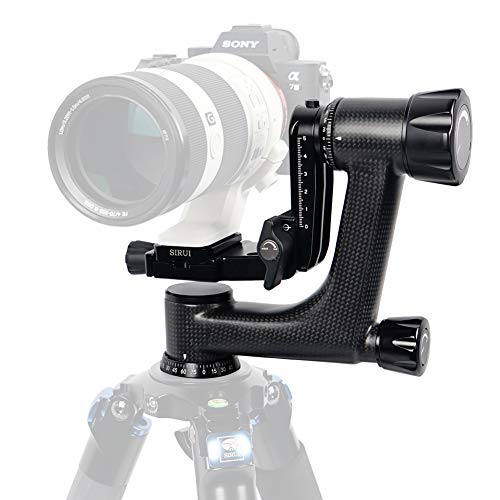
SIRUI PH-10 Gimbal Head, 360° Panoramic Tripod Head, 15kg, 600mm Telephoto
- Ten-layer carbon fiber body brings the head down to 0.98 kg — the lightest full gimbal in this group according to the manufacturer
- Four independent locking knobs for track, base, sliding platform, and quick-release plate give granular friction control
- 15 kg load limit is the lowest in this group — not suitable for 500 mm f/4 or larger lenses on a full-frame body
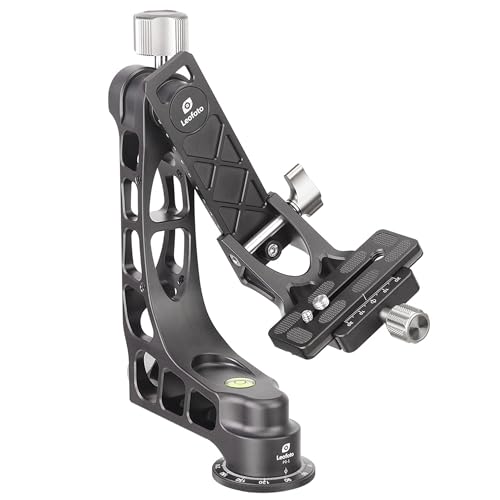
Leofoto PG-1 Gimbal Head for Telephoto Lenses, 55 lb Load, Arca-Swiss Clamp
- Manufacturer specifies 55 lb capacity in a head weighing just 2.2 lb — one of the strongest load-to-weight ratios listed here
- Integrated 1/4"-20 sockets on the vertical arm allow attaching monitors or flash units without additional adapters
- A newer listing with less of a track record than the Wimberley or Benro options
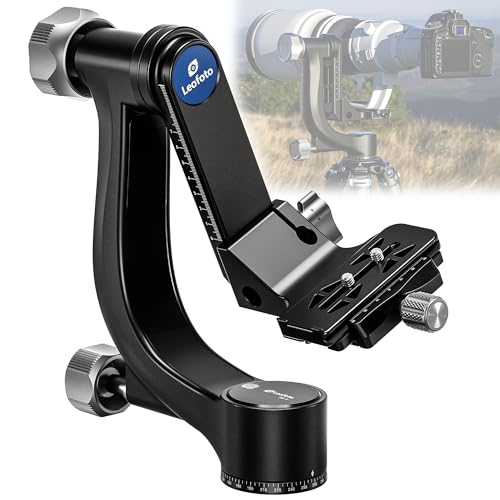
Leofoto Gimbal Head, Compact Outdoor Shooting Gimbal Head with 360° Pan Rotation
- Spirit level built into the panning base adds a precision reference point not found on every head in this group
- Numbered scales on the arm and plate allow repeat setup replication session to session, per the listing
- 100 mm height adjustment range is narrower than the longer sliding platforms on the Benro GH2N and Leofoto PG-1
Where to Buy
Benro Aluminum Gimbal Head (GH2N)See Benro Aluminum Gimbal Head (GH2N) on Amazon