Best CFexpress Type B Cards for Mirrorless Cameras

Affiliate disclosure: Some links on this page are affiliate links. If you buy through them we earn a small commission at no extra cost to you. Recommendations are research-driven; we don't claim personal use of every product reviewed. Product prices and availability are accurate as of the date published and are subject to change. Always check Amazon for current pricing before purchasing. Learn more.

Quick Picks
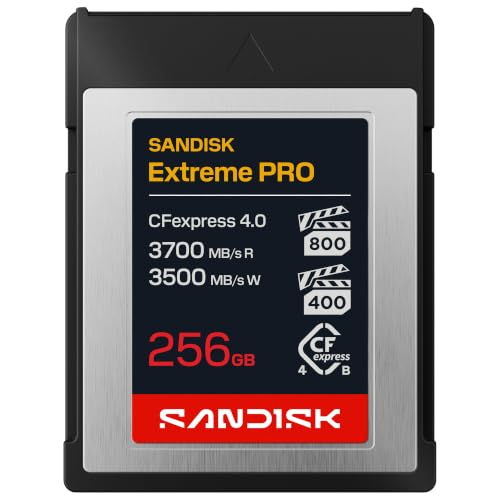
SANDISK 256GB Extreme PRO CFexpress 4.0 Type B, Up to 3700 MB/s Read Speeds
PCIe Gen4 technology enables up to 3700 MB/s read speeds, per the manufacturer
Buy on Amazon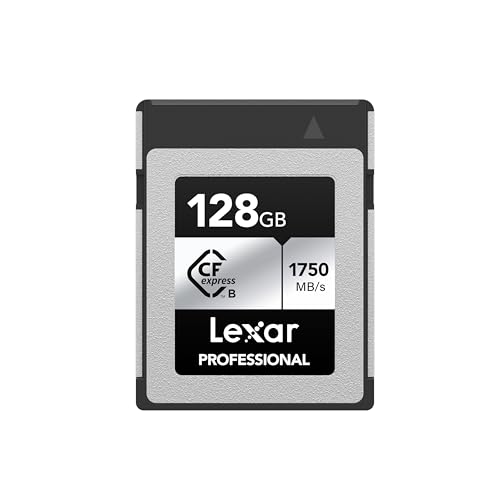
Lexar 128GB CFexpress Type B Silver 2.0 Card, 1750/1300 MB/s, 8K Video
Up to 1750 MB/s read and 1300 MB/s write on a CFexpress 2.0 spec well-matched to current mirrorless bodies
Buy on Amazon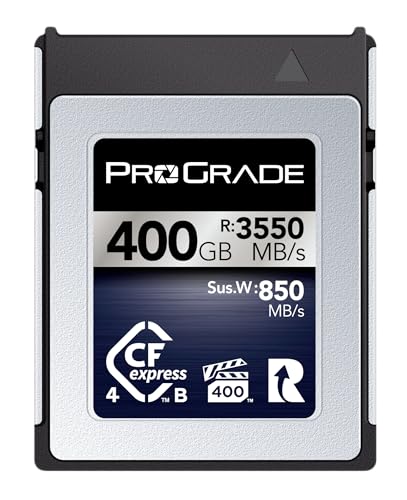
ProGrade Digital CFexpress 4.0 Type B Memory Card (400GB) Iridium
3550 MB/s read speed via PCIe 4.0 with laser-etched serial number for counterfeit protection, per the manufacturer
Buy on Amazon| Product | Price Range | Top Strength | Key Weakness | Buy |
|---|---|---|---|---|
| SANDISK 256GB Extreme PRO CFexpress 4.0 Type B, Up to 3700 MB/s Read Speeds best overall | $$ | PCIe Gen4 technology enables up to 3700 MB/s read speeds, per the manufacturer | VPG1600 certification applies only to 1TB–4TB capacities; smaller capacities carry lower VPG ratings | Buy on Amazon |
| Lexar 128GB CFexpress Type B Silver 2.0 Card, 1750/1300 MB/s, 8K Video best value | $$ | Up to 1750 MB/s read and 1300 MB/s write on a CFexpress 2.0 spec well-matched to current mirrorless bodies | CFexpress 2.0 interface will not deliver PCIe 4.0 speeds even in future Gen4-capable bodies | Buy on Amazon |
| ProGrade Digital CFexpress 4.0 Type B Memory Card (400GB) Iridium best premium | $$ | 3550 MB/s read speed via PCIe 4.0 with laser-etched serial number for counterfeit protection, per the manufacturer | Three-year warranty is shorter than the ten-year coverage Lexar offers on its Silver 2.0 card | Buy on Amazon |
| Lexar 512GB CFexpress Type B Silver 4.0 Card, 3600/3000 MB/s, 8K Video also consider | $$ | Up to 2600 MB/s sustained write speed on a PCIe 4.0 card designed for 8K RAW without dropped frames, per the manufacturer | Optimized workflow requires the separately sold Lexar Professional Workflow CFexpress 4.0 reader | Buy on Amazon |
| Delkin Devices Black 512GB CFexpress™ Type B 4.0 VPG400 Memory Card – High-Speed Performance for also consider | $$ | VPG400 certification guarantees a sustained write floor of 2040 MB/s, per the manufacturer | Warranty terms are not specified in the listing bullets, unlike cards that state multi-year coverage explicitly | Buy on Amazon |
| OWC Atlas Pro 512GB CFexpress 4.0 Type B Memory Card also consider | $$ | Fully compliant with CFexpress Type B 1.0, 2.0, and 4.0 specifications for broad camera compatibility, per the manufacturer | Maximum video use case cited as 6K, which may not satisfy cinematographers working in 8K RAW workflows | Buy on Amazon |
CFexpress Type B has become the standard slot on serious mirrorless bodies—Canon R5 and R5 II, Nikon Z8 and Z9, Panasonic S5 II and S1R among them—but the format now spans two distinct generations. PCIe 2.0 cards top out around 1750 MB/s read, which is all most current bodies can actually use. PCIe 4.0 cards push past 3500 MB/s read, which matters for offload time today and for cameras still arriving that can exploit the full bandwidth. The right choice depends on what your body supports, what you shoot, and how long you want the card to stay relevant.
These picks were chosen by comparing manufacturer specifications and current Amazon listings. This site does not test products. The Memory Cards hub covers the broader format landscape including CFexpress Type A and SD options if your body uses a different slot.
Top Picks
SANDISK 256GB Extreme PRO CFexpress 4.0 Type B
The SANDISK 256GB Extreme PRO CFexpress 4.0 Type B leads this guide on the strength of its specification sheet. According to the manufacturer, PCIe Gen4 technology enables read speeds up to 3700 MB/s—a ceiling that current Canon and Nikon bodies do not reach, but one that positions the card ahead of the next generation of firmware and hardware updates rather than behind them.
For video shooters, the manufacturer specifies minimum sustained write speeds of 3100 MB/s on 2TB–4TB capacities, with VPG1600 certification at those sizes. The 128GB–400GB variants carry VPG800 and VPG400 ratings, which remain well above the sustained write requirements for 8K RAW on any current body. VPG certification matters in practice because it defines a floor, not a peak—your camera’s buffer empties into a card that is contractually obligated by its own spec to stay above a minimum speed under sustained load.
One detail worth noting from the listing: SmartIdle technology is designed to shift the card into low-power mode when the camera goes idle. For photographers on long sessions or wildlife shoots where the camera sits ready between bursts, that is a meaningful design consideration. The manufacturer also specifies drop resistance up to 5 meters and bend resistance up to 70 newtons for durability in production environments.
Check current price on Amazon.
Lexar 128GB CFexpress Type B Silver 2.0 Card
Not every body needs Gen4 bandwidth, and the Lexar 128GB CFexpress Type B Silver 2.0 Card makes that argument clearly. The manufacturer specifies up to 1750 MB/s read and 1300 MB/s write—speeds that match or exceed what most current Canon R5 and Nikon Z6 III bodies can actually saturate through their CFexpress 2.0 interfaces. Paying for PCIe 4.0 headroom on a Gen2 body means paying for bandwidth the camera cannot use.
The listing notes backwards compatibility with select XQD cameras, which extends useful life for anyone transitioning from an older Nikon body. Lexar backs this card with a 10-year limited warranty—the longest coverage in this guide. For a photographer who shoots stills-heavy work, manages card budgets carefully, and is not planning a body upgrade to a Gen4-capable camera in the near term, the calculus here is straightforward.
Check current price on Amazon.
ProGrade Digital CFexpress 4.0 Type B Memory Card (400GB) Iridium
ProGrade has built a reputation in professional production circles for treating memory cards as infrastructure rather than accessories, and the ProGrade Digital CFexpress 4.0 Type B Memory Card (400GB) Iridium reflects that orientation. The manufacturer specifies a 3550 MB/s read speed via PCIe 4.0 and NVMe, with VPG400 certification to guarantee a sustained write floor for video. Compatibility with XQD devices via firmware update is also noted in the listing.
Two features distinguish the Iridium from competitors at similar speed tiers. First, each card carries a laser-etched serial number—a counterfeit protection measure that ProGrade specifies directly, which matters when buying through third-party marketplace sellers. Second, the listing references ProGrade’s Refresh Pro software, available separately, designed to help maintain card speed over time. That is a longer-term consideration that photographers investing in high-end card infrastructure will appreciate.
The trade-off is warranty coverage: ProGrade specifies a three-year warranty here, which is shorter than the ten-year coverage on the Lexar Silver 2.0 and the coverage periods offered by some competitors. For a working professional treating cards as depreciating production assets, three years may be entirely adequate. For someone who keeps gear for a long time, it is worth weighing.
Check current price on Amazon.
Lexar 512GB CFexpress Type B Silver 4.0 Card
The Lexar 512GB CFexpress Type B Silver 4.0 Card occupies an interesting position: it brings PCIe 4.0 performance at 512GB capacity with a ruggedness specification list that goes further than most cards in this roundup. The manufacturer specifies temperature-proof, vibration-resistant, dust-resistant (IP5X), 5-meter drop-proof, shock-resistant, bend-resistant, and 7x more compression-resistant than SD cards—a full catalog of environmental protections relevant to location and documentary work.
Performance-wise, the listing specifies up to 3600 MB/s read, 3000 MB/s write, and 2600 MB/s sustained write. That sustained write figure is the number that matters for 8K RAW workflows, and the manufacturer specifies it explicitly for seamless capture without frame drops. The card is also backwards-compatible with XQD devices per the listing.
One practical note: Lexar’s ecosystem recommendation is to pair this card with the Lexar Professional Workflow CFexpress 4.0 reader for full transfer speed. That reader is sold separately, so factor that into the total cost of the setup if fast offload is part of the workflow requirement.
Check current price on Amazon.
Delkin Devices Black 512GB CFexpress Type B 4.0
The Delkin Devices Black 512GB CFexpress Type B 4.0 leads with two specifications that matter most to video-first shooters: read speeds up to 3700 MB/s and write speeds up to 3220 MB/s, per the manufacturer, alongside VPG400 certification that guarantees sustained write performance at 2040 MB/s. For cinematographers recording 8K, 6K, or high-frame-rate 4K RAW, the combination of a high peak write speed and a certified sustained write floor addresses both burst handling and long-form recording reliability.
The listing also specifies that each card is uniquely serialized—a security and authenticity measure in line with what ProGrade offers on the Iridium. Durability specifications include shockproof and waterproof ratings alongside resistance to temperature extremes. The listing does not specify warranty duration explicitly, which is a gap worth noting before purchase if long-term coverage is a factor in the decision.
Check current price on Amazon.
OWC Atlas Pro 512GB CFexpress 4.0 Type B
Compatibility breadth is the defining characteristic of the OWC Atlas Pro 512GB CFexpress 4.0 Type B. The manufacturer specifies full compliance with CFexpress Type B 1.0, 2.0, and 4.0 specifications, which means this card works across a wider range of body generations than cards that focus only on the Gen4 spec. For photographers using multiple bodies—say, a newer Z9 and an older XQD-era Nikon—that cross-generation reliability has practical value.
Performance specifications from the listing reach up to 3650 MB/s read and 3000 MB/s write, positioned by the manufacturer for fast burst RAW image sequences and high-bitrate video up to 6K. That ceiling is worth noting: the OWC listing does not specify 8K RAW as a primary use case, which distinguishes it from the Delkin and Lexar 4.0 options in this guide. For photographers shooting stills-heavy work with periodic high-bitrate video needs, that distinction may be immaterial. For dedicated 8K video workflows, the cards above with explicit 8K RAW specifications are the stronger match.
Check current price on Amazon.
Buying Guide
CFexpress 2.0 vs. 4.0: What Your Camera Actually Uses
The most consequential decision in this format is whether your body can use PCIe 4.0 bandwidth at all. Most current mirrorless cameras—including the Canon R5, R6 Mark II, and Nikon Z6 III—use CFexpress Type B slots with PCIe 2.0 or 3.0 interfaces. Installing a 3700 MB/s Gen4 card in one of these bodies produces Gen2 speeds at Gen4 card pricing. The card is not wasted—it will still work, and offload speeds to a Gen4-capable reader will benefit—but the in-camera capture speed advantage disappears.
Nikon Z8 and Z9 bodies, and a growing number of cinema-adjacent bodies arriving with newer chipsets, are designed to exploit the Gen4 bandwidth more fully. If your body is confirmed Gen4-capable through manufacturer documentation, the speed premium on 4.0 cards translates directly into faster buffer clearing and more headroom for high-bitrate video. If it is not, a well-specified 2.0 card like the Lexar Silver 2.0 is the more efficient allocation. Check your camera manufacturer’s CFexpress compatibility page and the body’s firmware release notes before deciding.
Sustained Write Speed and VPG Certification for Video
Peak read speed is a marketing headline. Sustained write speed is what matters when the camera is recording. A card that achieves 3500 MB/s in a burst benchmark but drops to 400 MB/s after thirty seconds of sustained recording will produce dropped frames in demanding video modes.
VPG (Video Performance Guarantee) certification defines a minimum sustained write speed that a card must maintain. VPG400 means a 400 MB/s floor; VPG800 means 800 MB/s; VPG1600 means 1600 MB/s. For 4K RAW on current bodies, VPG400 is adequate. For 8K RAW or high-frame-rate 6K, VPG800 or VPG1600 becomes relevant depending on codec and bitrate. Several cards in this guide specify their VPG ratings directly; treat that certification as the more reliable video performance indicator than any peak write figure. The Memory Cards hub has additional context on VPG tiers across formats.
Capacity and Session Planning
At 8K RAW bitrates, a 128GB card fills faster than many photographers expect. The math varies significantly by codec, compression ratio, and frame rate, but as a general planning principle: higher-bitrate workflows need more capacity, not just more speed. The 512GB options in this guide address that directly. For photographers shooting primarily stills with occasional video, 128GB or 256GB is often workable when combined with a card rotation strategy during longer shoots.
One consideration specific to CFexpress Type B: most mirrorless bodies that accept this format have a single CFexpress slot, sometimes paired with a UHS-II SD slot. Redundancy recording—where both slots capture simultaneously—requires a second card, often of a different format. Capacity planning on the CFexpress card therefore needs to account for the full session length without assuming a second CFexpress backup.
Heat Management in Extended Recording
CFexpress Type B cards run warmer than SD cards under sustained load, which is a function of the PCIe interface and the speeds involved. Most professional bodies with CFexpress slots include thermal management in their firmware, and the cards themselves are designed within thermal envelopes that the camera manufacturers have validated. For run-and-gun video work with continuous recording, the cards in this guide are specified by their manufacturers for exactly that use case.
Where heat becomes a practical concern is in very high ambient temperatures—outdoor summer shoots, direct sun on the camera body—combined with maximum bitrate recording over extended durations. In those conditions, allowing the camera to cycle idle periods between takes is the standard professional practice. The SmartIdle feature on the SanDisk Extreme PRO 4.0 is designed specifically to take advantage of those idle cycles to reduce thermal load on the card.
Durability Specifications and What They Mean
CFexpress Type B cards are physically robust by design—the metal enclosure and NVMe controller architecture are more resilient than the NAND alone in an SD card package. The drop ratings, bend resistance figures, and IP ratings that manufacturers specify go beyond what most shooting environments require, but they are meaningful for travel photographers, field reporters, and cinematographers working in challenging locations.
The CFexpress Type A guide at /cfexpress-type-a-cards/ covers the smaller format used in Sony Alpha bodies for comparison. When evaluating durability claims, focus on the specifications directly relevant to your environment: IP5X dust resistance matters on location, drop resistance matters if cards leave the camera frequently, and bend resistance matters for cards stored in tight cases or pockets. All cards in this guide specify some combination of these protections; the Lexar Silver 4.0 provides the most comprehensive list of certified environmental ratings among the options covered here.
Frequently Asked Questions
Will a CFexpress 4.0 card work in a camera designed for CFexpress 2.0?
Yes—CFexpress Type B cards are backwards-compatible across generations. A 4.0 card installed in a 2.0-interface body will function correctly, but it will operate at the body’s interface speed limit rather than the card’s maximum. You will not see the full read or write speeds the card is capable of during capture. The advantage of using a Gen4 card in a Gen2 body shows up primarily when offloading files to a Gen4-capable card reader, where transfer speeds reflect the card’s ceiling rather than the camera’s.
What does VPG certification actually guarantee?
VPG (Video Performance Guarantee) is a minimum sustained write speed standard defined by the CompactFlash Association. A card rated VPG400 is certified to maintain at least 400 MB/s of write throughput continuously—not just at peak. Higher tiers (VPG800, VPG1600) guarantee proportionally higher sustained floors. The certification is relevant because a card’s peak write speed and its sustained write speed can differ significantly; VPG tells you the floor, which is what prevents dropped frames during long recording runs.
Is 128GB enough for 8K RAW video, or do I need 256GB or more?
It depends on codec, compression, and session length. 8K RAW at maximum bitrate fills storage faster than most photographers initially expect. For a short commercial shoot with controlled takes, 128GB can be workable with disciplined card rotation. For documentary work, event coverage, or any situation where recording runs continuously for extended periods, 256GB or 512GB provides meaningful margin. The 512GB options from Lexar, Delkin, and OWC in this guide are specifically positioned for high-capacity professional workflows.
How do the Lexar Silver 4.0 and the Delkin Devices Black 4.0 compare for 8K video?
Both are PCIe 4.0 cards with VPG400 certification and 512GB capacity. The Lexar Silver 4.0 specifies a 2600 MB/s sustained write speed per the manufacturer, while the Delkin Black specifies a 2040 MB/s VPG400 sustained write floor alongside peak write speeds up to 3220 MB/s. The Lexar listing provides more detailed ruggedness certifications including an IP5X dust resistance rating. The Delkin listing emphasizes its serialization for authenticity verification. For 8K RAW capture, both cards are specified to handle the task; the Lexar’s stated sustained write figure is higher, while the Delkin’s peak write speed is higher.
Do I need a CFexpress Type B card reader to use these cards, or will my existing reader work?
CFexpress Type B requires a Type B reader—the physical form factor is not compatible with CFexpress Type A readers or standard SD card readers. If your current reader is XQD-only, it may or may not support CFexpress depending on its firmware; some XQD readers have been updated via firmware to support CFexpress Type B. For PCIe 4.0 cards, a Gen4-capable reader is needed to realize full transfer speeds during offload. Using a Gen4 card with a Gen2 reader will work but will cap transfer speeds at the reader’s interface limit, not the card’s.
SANDISK 256GB Extreme PRO CFexpress 4.0 Type B, Up to 3700 MB/s Read Speeds
- PCIe Gen4 technology enables up to 3700 MB/s read speeds, per the manufacturer
- SmartIdle technology reduces power draw when the camera goes idle, per the listing
- VPG1600 certification applies only to 1TB–4TB capacities; smaller capacities carry lower VPG ratings
Lexar 128GB CFexpress Type B Silver 2.0 Card, 1750/1300 MB/s, 8K Video
- Up to 1750 MB/s read and 1300 MB/s write on a CFexpress 2.0 spec well-matched to current mirrorless bodies
- Backwards-compatible with select XQD cameras, per the manufacturer
- CFexpress 2.0 interface will not deliver PCIe 4.0 speeds even in future Gen4-capable bodies
ProGrade Digital CFexpress 4.0 Type B Memory Card (400GB) Iridium
- 3550 MB/s read speed via PCIe 4.0 with laser-etched serial number for counterfeit protection, per the manufacturer
- Includes ProGrade Digital Refresh Pro software support to help maintain card speed over time
- Three-year warranty is shorter than the ten-year coverage Lexar offers on its Silver 2.0 card
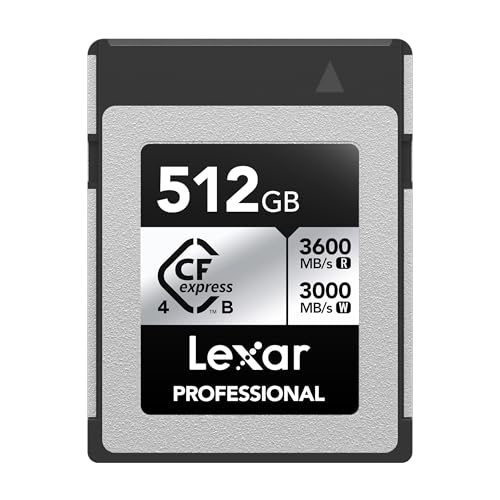
Lexar 512GB CFexpress Type B Silver 4.0 Card, 3600/3000 MB/s, 8K Video
- Up to 2600 MB/s sustained write speed on a PCIe 4.0 card designed for 8K RAW without dropped frames, per the manufacturer
- IP5X dust resistance plus 5-meter drop protection in a rugged enclosure, per the listing
- Optimized workflow requires the separately sold Lexar Professional Workflow CFexpress 4.0 reader
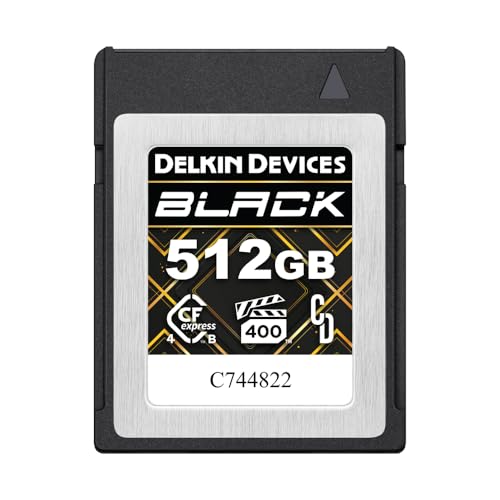
Delkin Devices Black 512GB CFexpress™ Type B 4.0 VPG400 Memory Card – High-Speed Performance for
- VPG400 certification guarantees a sustained write floor of 2040 MB/s, per the manufacturer
- Read speeds up to 3700 MB/s and write speeds up to 3220 MB/s on PCIe 4.0, per the listing
- Warranty terms are not specified in the listing bullets, unlike cards that state multi-year coverage explicitly
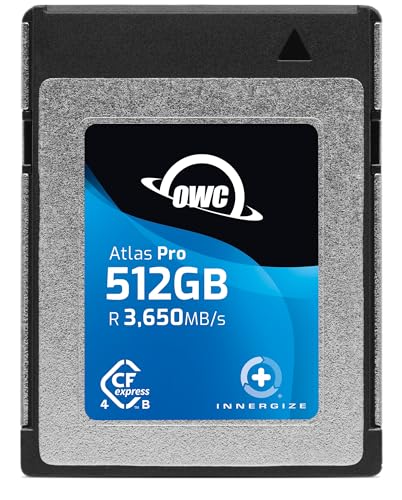
OWC Atlas Pro 512GB CFexpress 4.0 Type B Memory Card
- Fully compliant with CFexpress Type B 1.0, 2.0, and 4.0 specifications for broad camera compatibility, per the manufacturer
- Up to 3000 MB/s write and 3650 MB/s read speeds positioned for burst RAW sequences and high-bitrate video, per the listing
- Maximum video use case cited as 6K, which may not satisfy cinematographers working in 8K RAW workflows
Where to Buy
SANDISK 256GB Extreme PRO CFexpress 4.0 Type B, Up to 3700 MB/s Read SpeedsSee SANDISK 256GB Extreme PRO CFexpress 4… on Amazon