
Lexar 512GB Professional Gold CFexpress 4.0 Type B Card Reviewed

Affiliate disclosure: Some links on this page are affiliate links. If you buy through them we earn a small commission at no extra cost to you. Recommendations are research-driven; we don't claim personal use of every product reviewed. Product prices and availability are accurate as of the date published and are subject to change. Always check Amazon for current pricing before purchasing. Learn more.

High sustained write speed for burst shooting and 4K video
See Lexar 512GB Professional CFexpress Ty… on AmazonCFexpress Type B cards have become the default choice for serious photographers and videographers running the latest generation of mirrorless cameras , but not all cards perform equally under sustained load. The gap between peak specifications and real-world sustained throughput is where buying decisions actually live, and it is wider in CFexpress than in any previous card format. Exploring the full range of memory cards available before committing to a format will save time and prevent compatibility headaches.
The Lexar Professional Gold CFexpress 4.0 Type B 512GB is the target here, but the research for this guide surfaced two additional Lexar options worth covering , a 256GB CFexpress Type B Gold and two CFexpress Type A Silver 4.0 cards , because many buyers discover mid-research that their camera body uses a different form factor than they assumed.
What to Look For in a CFexpress Memory Card
Read and Write Speed Ratings , And What They Actually Mean
Peak read and write figures dominate marketing materials, and they are useful as a ceiling , no card will exceed them under any condition. But sustained write speed under continuous load is the figure that determines whether your buffer clears fast enough during burst sequences or whether the camera throttles before the end of a scene.
A card rated at 1750 MB/s read may sustain only 900, 1200 MB/s in real shooting conditions, depending on thermal behavior and controller design. Owner feedback on r/SonyAlpha and r/Fujifilm consistently distinguishes between cards that hold speed through a full RAW burst and those that stutter at high temperatures. Read speed governs offload performance , how quickly your card empties when connected to a card reader. For shooters who work with large batches, this matters significantly.
PCIe Generation: 3.0 vs. 4.0
CFexpress Type B cards using PCIe 3.0 and NVMe have been the standard since the format launched. PCIe 4.0 doubles the available bandwidth ceiling, which is why the newer Gold 4.0 cards carry higher peak specifications than the previous generation Gold series. However, the camera body must support PCIe 4.0 to take advantage of the additional headroom.
Most current Sony Alpha, Canon EOS R, and Nikon Z cameras supporting CFexpress Type B were designed around PCIe 3.0. A 4.0 card will function in a 3.0 body , but it will operate at the 3.0 speed ceiling, not at the card’s rated maximum. The practical benefit of purchasing a 4.0 card today is primarily forward-compatibility as newer body generations arrive.
Form Factor Compatibility: Type A vs. Type B
CFexpress Type A and Type B are not interchangeable. Type B is larger and delivers higher throughput; Type A is closer in size to a standard SD card and is used in Sony bodies such as the A7 IV, A7R V, and FX30 through a dual-slot that accepts either format. Type B is used in Canon EOS R3, R5, R6 series, Nikon Z9, Z8, Z6III, and others.
Confirming which slot type your camera uses before purchasing is essential. The failure mode , spending on a premium card that physically cannot fit the slot , is entirely avoidable. Camera manufacturer compatibility pages and the relevant Reddit communities for your body are reliable confirmation sources.
Capacity Planning for Your Shooting Style
For still photographers shooting RAW, 256GB is a practical floor for a full day of event or portrait work. Sports and wildlife shooters generating extended bursts will fill cards faster than studio shooters; 512GB reduces the number of swaps required on long shoots. Videographers working in RAW or high-bitrate formats , particularly 6K and 8K continuous recording , will find that sustained write speed and total capacity both factor into session planning.
A useful frame from the broader memory card landscape: higher capacity cards of the same model line generally share the same speed specifications as their smaller counterparts, so the choice between 256GB and 512GB is primarily about volume rather than performance tier.
Reliability Indicators and Warranty Coverage
Lexar cards carry a limited lifetime warranty , a positive signal for long-term confidence, though the practical value depends on the manufacturer’s RMA process. Owner reviews across Amazon and camera-specific forums show low failure-report rates for the Professional Gold series over multi-year ownership windows. Temperature ratings and shock resistance specifications are standardized across CFexpress cards at the format level, but thermal throttling behavior under sustained video recording load varies more than specs suggest.
Top Picks
Lexar 256GB Professional CFexpress Type B Memory Card GOLD Series
The Lexar 256GB Professional CFexpress Type B Memory Card GOLD Series is the reference starting point for most Type B buyers. Rated to 1750 MB/s read and using PCIe 3.0 and NVMe, it covers the performance tier that current Canon EOS R5, R6 Mark II, and Nikon Z9 and Z8 bodies are designed to extract from. Verified buyers shooting 45 MP and above RAW files in burst sequences consistently report buffer clearing without stall on this card.
This is the PCIe 3.0 generation Gold card , which means every current camera body that supports CFexpress Type B will operate it at full rated performance, without any version mismatch. For buyers whose bodies are not PCIe 4.0-ready, there is no practical reason to pay more for a 4.0 card today. Owner consensus across Amazon reviews and Nikon Z9 communities specifically positions this card as a reliable daily-use option for sports and wildlife RAW burst work.
Sustained write performance , the figure that governs long-form video recording and buffer drain rates , holds well according to extended continuous-recording owner reports. The 256GB capacity is appropriate for most single-day shoots; two-card rotation handles multi-day work without requiring higher capacity.
Check current price on Amazon.
Lexar 512GB Professional CFexpress Type A Silver 4.0 Memory Card
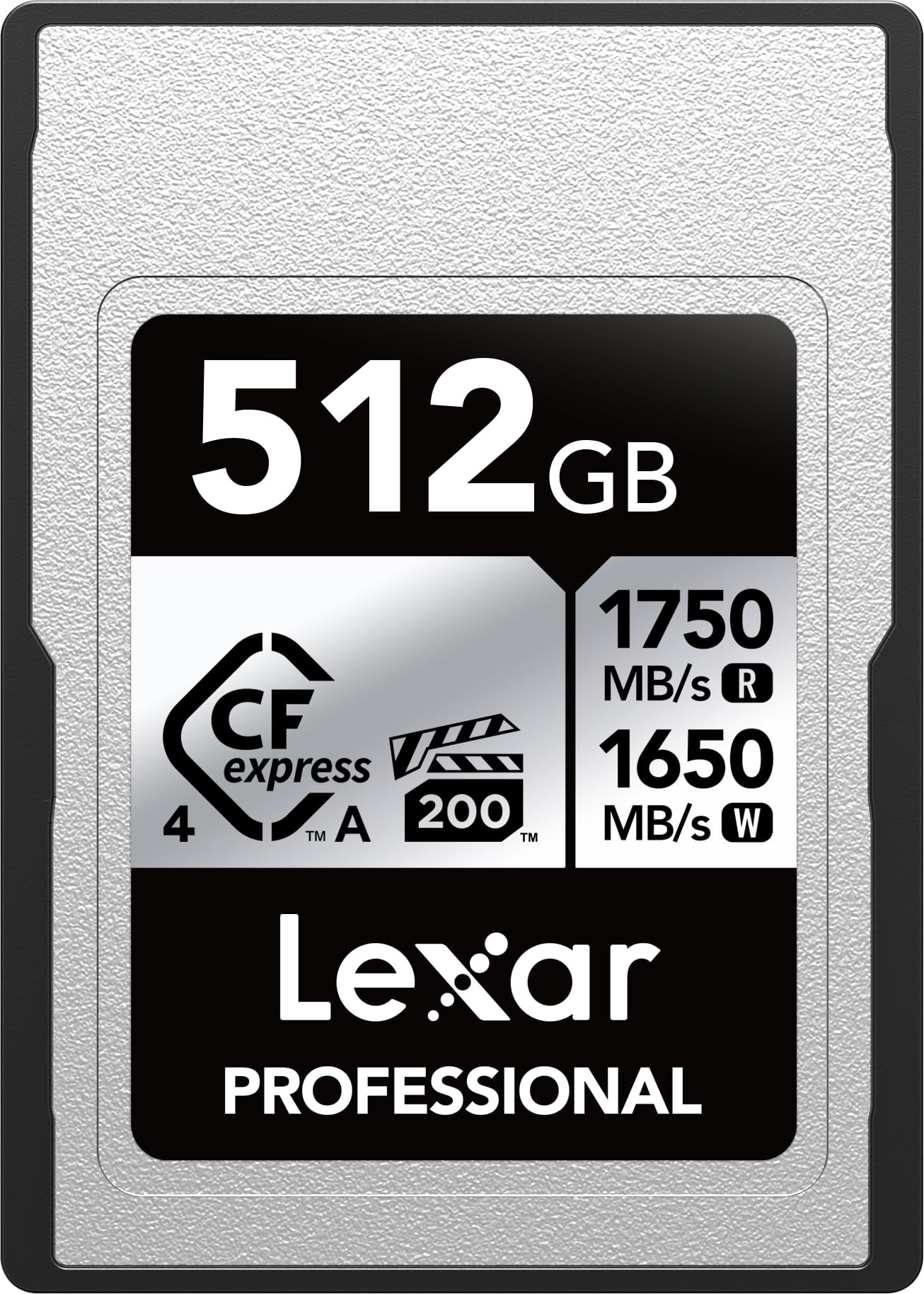
The Lexar 512GB Professional CFexpress Type A Silver 4.0 Memory Card is the right card for Sony shooters running bodies with the dual-slot Type A / SD configuration , A7 IV, A7R V, A7C II, FX30, and similar. Peak specifications sit at 1750 MB/s read and 1650 MB/s write, which positions this squarely at the top of what Type A physically supports at current bandwidth ceilings.
The 4.0 designation here refers to the PCIe generation on the card controller. Sony’s current bodies with CFexpress Type A slots operate on PCIe 3.0, meaning the card’s 4.0 headroom goes unused on current hardware , but the sustained write performance at real-world speeds remains competitive, and buyers investing in a higher-end card now carry forward-compatibility as newer Sony bodies arrive. Photographer communities on r/SonyAlpha identify Lexar Type A Silver as a consistently reliable performer for the A7R V’s compressed RAW burst workflow, where sustained write pressure is among the most demanding scenarios in the mirrorless market outside cinema bodies.
At 512GB, this card handles extended event coverage or a full day of 4K high-bitrate video without requiring a swap. The capacity premium over the 256GB version is the primary trade-off, and for photographers who work longer sessions or prefer single-card days, the case for the larger format is strong.
Check current price on Amazon.
Lexar 256GB Professional CFexpress Type A Silver 4.0 Memory Card
For Type A Sony shooters who do not need 512GB , or who prefer to run multiple smaller cards across a two-slot workflow , the Lexar 256GB Professional CFexpress Type A Silver 4.0 Memory Card delivers the same rated specifications as its 512GB sibling: 1750 MB/s read and 1650 MB/s write. The speed tier is identical; the only variable is total capacity.
Owner reports on the Sony A7C II and FX30 pair this card with the same sustained-write confidence as the 512GB version. For portrait and studio shooters generating moderate file volumes , or for photographers running a two-card redundancy strategy , the 256GB size provides enough headroom per session without the capacity overhead of the larger card. The 4.0 generation controller offers the same forward-compatibility argument as the 512GB version: current Sony bodies won’t tax the PCIe 4.0 ceiling, but the sustained write throughput at PCIe 3.0 operating speeds remains strong.
The practical decision between this card and the 512GB version is straightforward: if you routinely fill 256GB in a single session or find yourself managing card swaps more than you’d like, step up. If your typical shooting volume fits comfortably within 256GB, the smaller card provides identical performance in the scenarios you’ll actually encounter.
Check current price on Amazon.
Buying Guide
Confirming Your Camera’s CFexpress Slot Type Before Purchase
The single most common CFexpress buying error is purchasing the wrong form factor. Type A and Type B are incompatible , the slots are different sizes and the cards are not interchangeable in any configuration. Canon EOS R bodies and Nikon Z9, Z8, Z6III use Type B. Sony Alpha mirrorless bodies with CFexpress support , A7 IV, A7R V, A7C II, FX30, ZV-E1 , use Type A via a dual-format slot that also accepts UHS-II SD.
Verify the slot type in your camera’s manual or manufacturer specification page before purchasing. Reddit communities for your specific body are a reliable second confirmation; compatibility questions come up frequently and recent posts reflect current firmware states.
PCIe Generation Matching: When 4.0 Adds Value
CFexpress Type B cards are available in both PCIe 3.0 and PCIe 4.0 variants. The 4.0 cards carry higher peak specifications, but that headroom is only accessible if the camera body supports the PCIe 4.0 interface. Most current bodies do not.
For buyers with current-generation Canon, Nikon, or Sony bodies, a PCIe 3.0 card will operate at full rated performance. Paying for a PCIe 4.0 Type B card today is a forward-compatibility bet on a future body upgrade , not a performance gain on existing hardware. For CFexpress Type A, the same logic applies: current Sony bodies use PCIe 3.0, and Type A 4.0 cards operate within those limits.
Capacity Selection and Shooting Volume
256GB and 512GB represent the two practical options in the current Lexar Professional lineup covered here. For still photographers, the relevant variable is file size multiplied by typical shot volume per session. A Sony A7R V generating uncompressed full-frame RAW files at roughly 60 MB each will fill 256GB after approximately 4,200 frames , comfortably more than most event or portrait days require.
Videographers calculating capacity need to factor bitrate and recording duration directly. High-bitrate 4K and 6K workflows consume storage faster than still photographers expect. Reviewing the full range of memory card options organized by format and capacity is a practical step for matching card size to production workflow requirements.
Sustained Write Speed and Buffer Behavior
Peak write speed ratings define the ceiling; sustained write speed under load defines actual behavior. Cards that throttle under extended burst sequences or continuous video recording cause the camera buffer to fill faster, which either limits burst depth or forces recording pauses.
Owner feedback from high-resolution mirrorless communities , particularly shooters using cameras with deep RAW burst buffers , consistently identifies sustained write speed as the differentiating factor between premium CFexpress cards and value-tier options. Lexar Professional Gold and Silver cards sit in the tier where sustained performance closely tracks the peak specifications, which is the reason they appear across professional and serious-enthusiast camera recommendations.
Warranty and Long-Term Reliability
Lexar Professional cards carry a limited lifetime warranty. Failure rates in owner reviews over multi-year windows are low for the Professional Gold and Silver lines, though no flash storage medium carries a zero-failure guarantee. Standard professional practice for critical work , paid assignments, unrepeatable events , is to shoot across two cards in simultaneous write mode wherever the body supports dual-slot recording, and to verify card health periodically using the manufacturer’s formatting tools or the body’s built-in diagnostic if available.
Frequently Asked Questions
What is the difference between CFexpress Type A and CFexpress Type B?
CFexpress Type A and Type B differ in physical size and maximum throughput. Type A is smaller and designed for Sony’s dual-format slots , the same slot that accepts UHS-II SD cards , while Type B is larger and used in Canon EOS R, Nikon Z9, Z8, and Z6 series bodies. Type B supports higher peak bandwidth due to its two PCIe lanes versus Type A’s single lane. The two formats are physically incompatible and cannot be used interchangeably.
Will a CFexpress Type B PCIe 4.0 card work in my current camera?
Yes, a PCIe 4.0 CFexpress Type B card is backward-compatible with PCIe 3.0 camera slots. The card will function normally in your body, but it will operate at the PCIe 3.0 speed ceiling rather than at its rated 4.0 maximum. Most current Canon EOS R and Nikon Z bodies are PCIe 3.0 devices. Purchasing a 4.0 card today is primarily a forward-compatibility investment for future body upgrades.
Is the Lexar 256GB Gold Series CFexpress Type B fast enough for RAW burst shooting on the Nikon Z9 or Z8?
Verified owner reports from Z9 and Z8 shooters indicate that the Lexar 256GB Professional CFexpress Type B Gold Series clears the RAW burst buffer reliably at the card’s rated 1750 MB/s read performance. Sustained write speed holds well under continuous burst pressure in owner testing documented across Nikon communities. It is a widely recommended option in the Nikon Z system CFexpress Type B tier.
Should Sony A7R V or A7 IV shooters choose the 256GB or 512GB CFexpress Type A Silver card?
The choice is primarily about session volume rather than performance , both the Lexar 256GB Type A Silver and Lexar 512GB Type A Silver share identical speed specifications. Photographers who shoot high-volume events, extended portrait sessions, or consecutive shooting days without offloading will find the 512GB version reduces card management overhead. For moderate-volume still shooting, 256GB covers a full session comfortably.
Does CFexpress card capacity affect write speed?
Within the same card model line, capacity typically does not affect rated write speed , the Lexar 256GB and 512GB Type A Silver 4.0 cards carry identical peak specifications. Speed ratings vary between product lines and generations, not between capacity tiers within the same line. The primary reason to choose a larger capacity card is volume management, not performance. Thermal behavior under sustained load may vary slightly between capacity tiers depending on controller design, but owner-reported differences at this level are not well-documented for the Lexar Silver 4.0 line.
Lexar 512GB Professional CFexpress Type A Silver 4.0 Memory Card, for Photographers, Videographers, Up to max 1750/1650 MB/s, 8K Video (LCAEXS4512G-RNENU): Pros & Cons
- High sustained write speed for burst shooting and 4K video
- Reliable read speed for fast offload
- Higher-performance cards cost more than standard options
Where to Buy
Lexar 512GB Professional CFexpress Type A Silver 4.0 Memory Card, for Photographers, Videographers, Up to max 1750/1650 MB/s, 8K Video (LCAEXS4512G-RNENU)See Lexar 512GB Professional CFexpress Ty… on Amazon